
Repair & diagnostics // Milwaukee & SE Wisconsin
Scissor lift and boom lift repair, diagnosed before it's quoted.
Shop and field service across Milwaukee and southeastern Wisconsin. Machines accepted from anywhere.
The analyzer goes on before the wrench does. You hear the fault, the plan, and the price before any work begins.
SERVICE FOR JLG · SKYTRAK · GRADALL · LULL · SKYJACK · GENIE · SNORKEL · NIFTY LIFT
How we diagnose
We read the fault before we touch a wrench.
The analyzer plugs in first. Blink codes and service fault codes get read, and the failure gets traced to the component: a valve, a cylinder, a contactor, a harness. Not the symptom, the cause. Then you hear the findings, the plan, and the price before any work begins. Parts changing is not a repair strategy, and you should never pay for guesses.

Intake
Model, serial, symptoms, and a photo of the data plate. We log the machine and the fault you are seeing, then route it: field visit or shop bay.
Diagnose
Fault codes read with the analyzer, then traced to the failing component. A drift on lift is a valve or a cylinder, not a guess.
Plan
You hear what we found, what it needs, and what it will cost, before any work begins. Approve it or walk away. No surprise invoices.
Repair
Fixed to spec by the same people who diagnosed it, with genuine parts matched to your serial number.
Return
Function-tested and documented from intake to return. If the annual inspection was due, the paperwork goes back with the machine.
Slab and rough terrain
Scissor lift repair
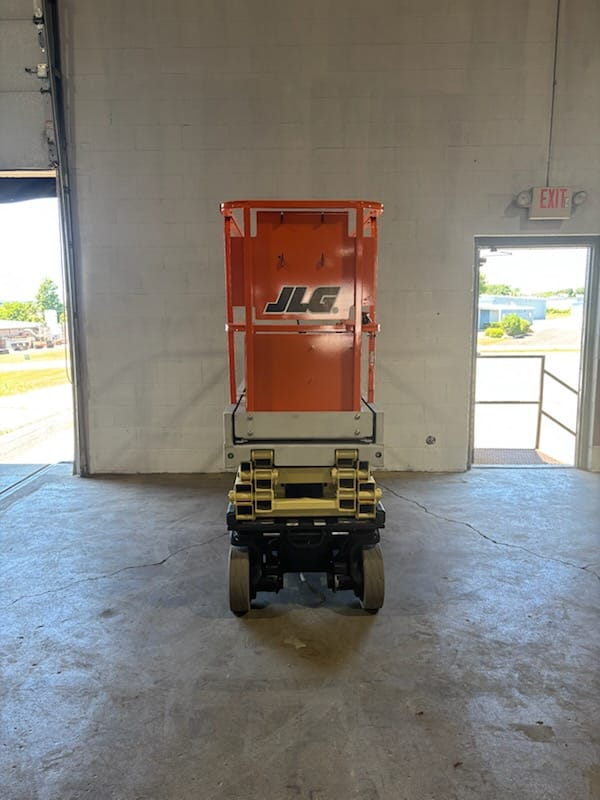
Most scissor lift problems walk through our door as one of a handful of faults: drift on lift, dead or erratic joystick and ground controls, charging and battery faults on electric slab units, tilt sensor trips that stop the platform mid-job, and pothole protection that binds and throws a fault. We see them daily on Genie GS units, Skyjack SJIII series, and JLG electric scissors, from 19 foot slab machines to 33 foot rough terrain units.
The analyzer tells us whether the fault lives in a valve, a cylinder, a contactor, or a harness before anything comes apart. Charging faults and control failures are often field-repairable at your site; hydraulic teardowns come into the shop. Either way the machine is documented from intake to return, and the plan and price come before the work.
Request scissor lift repairArticulating and telescopic
Boom lift repair
Articulating and telescopic booms fail differently than scissors, and we work on both: envelope and interlock faults that lock the boom out of its working range, hydraulic leaks at cylinders, hoses, and valve blocks, engine work on diesel and dual-fuel units, and the control and sensor faults that show up as a machine that will drive but will not lift. Genie Z and S series, JLG articulating and telescopic booms, and the related telehandler family all come through the shop.
Plenty of boom work is field-repairable: hoses, switches, sensors, charging systems. Boom teardowns, turntable work, and structural jobs come into Germantown, where the machine gets a bay instead of a parking lot. Diagnosis decides which, and you get the honest answer either way.
Request boom lift repairThe full boom lift repair process →
SkyTrak, Gradall, Lull, JLG
Telehandler repair

Telehandlers earn their keep and wear accordingly. The work we see most: boom wear pads that let the boom sag and chatter, extend and retract chains stretched past spec, hydraulic faults in tilt and crowd cylinders, and no-start and electrical problems that trace back to grounds, relays, and tired harnesses. SkyTrak, Gradall, Lull, and JLG telehandlers are the core of it, and the family shares enough parts and layout that a shop that knows one knows the others.
Wear items are the honest conversation here: pads and chains are maintenance, not mystery failures, and catching them early makes it a small job instead of a big one. Diagnosis first, plan and price before the work, documented return.
Request telehandler repairForklifts and material handling
Forklift repair
Warehouse forklifts run through the same bay as the lifts. If it runs on hydraulics and an engine or a battery pack, the technicians who diagnose scissor lifts and telehandlers can work on it. Sit-down counterbalance trucks, walk-behinds, and the related material handling equipment that keeps a building moving get the same intake: serial number and data plate first, symptoms written down, then diagnosis before anyone quotes the work.
The failures look a lot like what we see on lifts. Hydraulic leaks and slow lift circuits, mast chains and wear pads out of spec, no-start and electrical problems that trace back to grounds, relays, and tired harnesses, and control faults that need the plate to pin down the exact configuration.
Parts depend on the brand. Aerial lift parts, we stock and source every day; forklift parts access varies by brand, so we tell you which parts we can get and how long they take before the machine comes apart. If a part is going to hold up the repair, you hear that up front.
Send the model, the serial, and a photo of the data plate and we will tell you what we can do.
Request forklift repairThe full forklift repair process →What we work on
Four systems, one shop.
Hydraulic repair
Cylinders, pumps, valve blocks, and the leaks nobody else can find. Drift, slow lift, and creep all trace back to hydraulics, and the analyzer plus a pressure gauge finds which component is lying.
Electrical and fault codes
Harnesses, contactors, joysticks, ground controls, and sensor faults. Blink codes and service fault codes read with the analyzer, then traced to the component instead of guessed at.
Engine work
Diesel and dual-fuel engine service on booms and telehandlers, from routine service through no-start diagnosis and repair. Fuel, air, and electrical treated as one system, because that is how engines fail.
Chains and wear parts
Lift chains, extend chains, boom wear pads, and the consumables that keep a machine tight. Measured against spec, replaced with serial-matched parts, documented so the next inspection is boring.
Machine's not down? Its annual inspection is due every 12 months.
Book an inspectionStart the intake
Open a repair work order.
Symptoms, fault codes, and a serial number get you the fastest, most accurate answer. We reply during shop hours, Monday to Friday, 7:00 AM to 4:30 PM Central.
Rental fleet
Need a machine while yours is in the shop?
Our main focus is supporting the customer. We keep a small rental fleet, and rental options are available while your unit is in for repair. Ask when you open a work order.
Questions
Repair questions.
How much does scissor lift repair cost?
We diagnose before we quote, so the honest answer starts with the fault. The analyzer goes on, we trace the failure, and you hear what we found, what it needs, and what it will cost before any work begins. You approve the plan or you walk away. No surprise invoices, no parts you did not sign off on.
Do you come to the job site?
Yes. Field service covers Milwaukee and southeastern Wisconsin, out to Madison, within about 100 miles of our Germantown shop. Plenty of repairs are field-repairable: hoses, sensors, switches, charging faults. Bigger jobs like boom teardowns come into the shop, and we will tell you which is which after diagnosis.
What brands do you repair?
JLG, SkyTrak, Gradall, Lull, Skyjack, Genie, Snorkel, and Nifty Lift, plus related equipment. Scissor lifts, boom lifts, and telehandlers are the daily work. If you run something outside that list, call the shop and ask. A person who knows these machines answers the phone.
How long does a repair take?
It depends on the fault and the parts, and the diagnosis is what tells you. Once the analyzer has found the actual failure, we give you the plan: what it needs, what it costs, and how long it should take. Some field repairs are done the same visit. Shop jobs run with the machine documented from intake to return.
Do you repair machines from outside Wisconsin?
The shop accepts machines from anywhere. Ship or truck a unit to Germantown and it goes through the same intake, diagnosis, and documented return as a local machine. Field repair covers southeastern Wisconsin within about 100 miles of our Germantown shop, and it stays in Wisconsin.
Do you use genuine parts?
We quote genuine parts matched to your serial number. The data plate tells us exactly which configuration your machine is, so the part that arrives fits the machine you actually own, not just the model name. That is why intake asks for the serial or a photo of the plate.
Do you rent machines?
We keep a small rental fleet, mainly to keep you working while your unit is in our shop. Ask when you open a work order and we will tell you what is available.