
Resources // Inspections
What a scissor lift annual inspection covers, and what fails most.
The 12-month ANSI A92 inspection in plain language: what actually gets examined, how it differs from the checks your operators already do, and the components that turn up worn most often.
Start here
Three different inspections, often confused
Most confusion about aerial lift inspections comes from treating three separate things as one. They have different scopes, different intervals, and different people responsible for them.
The pre-shift or daily check belongs to the operator. Before the machine is used, somebody walks around it: controls respond, guardrails and gates are sound, tires and wheels look right, no obvious leaks or damage, the placards and manual are present, and the emergency lowering function is where it should be and reachable from the ground. It takes a few minutes and it is the check that catches most day-to-day surprises.
The frequent inspection is a deeper look on a shorter cycle than annual, driven by how hard the machine works. A lift running two shifts in a warehouse earns attention sooner than one that comes out a few times a month.
The annual inspection is the one this guide is about. It happens every 12 months, it is performed by a qualified person, and it produces a written record. It is an examination of the whole machine against the manufacturer requirements and the standard, not a walk around.
Scope
What the annual inspection covers
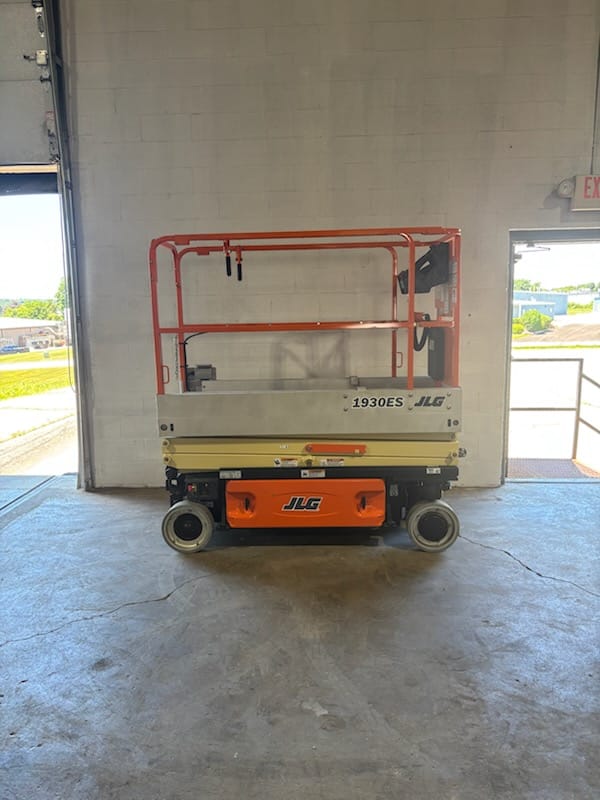
Structure and welds
The scissor stack, base frame, platform, and guardrails get examined for cracks, deformation, and damaged or missing fasteners. Pins and bushings get checked for wear, because that is where slop in the stack usually starts.
Hydraulics
Cylinders, hoses, fittings, and the power unit are checked for leaks, chafing, and damage. Holding and safety valves are verified, because those are what keep an elevated platform where you left it.
Electrical and controls
Ground and platform controls, the emergency stop at both stations, wiring and harnesses, connectors, and battery condition. Controls are checked for correct response, not just for signs of life.
Safety systems
Tilt sensing, pothole protection, guardrail interlocks, the platform gate, and the emergency lowering function. These are the systems that decide whether the machine allows an unsafe condition to continue.
Wheels, brakes, and drive
Tire condition, wheel security, brake function and holding, and drive operation. On a machine that spends its life on smooth slab these age slowly; on rough terrain they do not.
Decals and documentation
Capacity placards, warning decals, the serial and data plate, and the presence of the operator manual on the machine. Missing or unreadable decals are a real finding, not a technicality: they carry the load limits.
Findings
What turns up worn most often
Patterns repeat across scissor lifts regardless of badge, and none of them are exotic.
Batteries and charging. On electric machines this is the most common source of complaints that get blamed on something else. Cells that no longer hold a charge through a shift, corroded terminals, cables with damaged insulation, and chargers that are not delivering what they should. A machine that seems weak at height is often a machine with tired batteries.
Hydraulic seepage. Not usually a burst hose, but a slow weep at a fitting or a cylinder rod that leaves a mark on the deck overnight. Caught early it is a seal. Left alone it becomes a cylinder.
Pins and bushings. Wear in the scissor stack shows up as play and noise. It is a maintenance item, and it is far cheaper to address when it is measured as wear than when it has begun to elongate the holes it rides in.
Decals and manuals. Genuinely the most frequent write-up, and the easiest to fix. Decals get scrubbed off, painted over, or scraped away, and the manual disappears from the holder. Both are required to be there and legible.
Interlocks that have been worked around. A gate switch taped, a pothole bar that no longer deploys freely, a tilt alarm somebody silenced. These get the most serious write-ups because they remove the protection the machine was designed around.
Outcomes
Pass, fix, or red tag
An inspection ends in one of three places. The machine passes and you get the documentation. Findings are corrected and the machine goes back to work documented, which is common when the inspector is also the technician. Or the machine gets red-tagged.
A red tag means the machine should not be operated until the identified problem is corrected. It is a clear physical signal so nobody puts it back into service without knowing. The tag comes with the reason written down, which makes the route back to service specific: this component, this condition, this correction.
The written record matters beyond the day of the inspection. It shows what was examined, what was found, and what was done, and it is the thing that demonstrates a machine has been maintained rather than merely used.
If a unit is due or close to due, annual inspections can run in the shop or in the field, and a fleet on the same cycle is usually best batched into one visit.
Questions
Inspection questions
How often does a scissor lift need an annual inspection?
Every 12 months. ANSI A92 allows a small amount of room past that date, but the sensible way to run a fleet is on a 12-month cycle rather than against the outer edge of one. Machines drift out of cycle quietly, usually because nobody owns the calendar, and the fix is assigning it to somebody rather than remembering it.
What is the difference between a daily check and an annual inspection?
Scope and who does it. The daily or pre-shift check is the operator confirming the machine is safe to use right now: controls, guardrails, tires, fluid, obvious damage, and that the emergency lowering function is present and reachable. The annual inspection is a qualified person going through the machine against the manufacturer requirements and the standard, with the result written down. One is a walk around before work. The other is an examination with documentation.
What does a red tag actually mean?
That the machine should not be operated until the identified problem is corrected. It is not a punishment and it is not paperwork for its own sake: it is a clear signal on the machine so nobody unknowingly puts it back into service. The tag comes with the reason written down, so the path back to service is specific rather than vague.
How long does an inspection take?
It depends on the machine and what turns up, so an honest answer is a range rather than a promise. A clean, well-maintained electric scissor lift moves through quickly. A machine with deferred maintenance takes longer because every finding has to be recorded, and some findings lead to further checking. Batching a fleet into one visit is usually faster per unit than scheduling them one at a time.
Who is allowed to perform one?
ANSI A92 requires a qualified person: someone with the training and experience to know these machines and judge them honestly. In practice that usually means a technician who repairs this equipment regularly, because recognizing a worn component is a different skill from reading a checklist.
Start the intake
Book an inspection.
Model, serial, and how many units get you on the schedule fastest. We reply during shop hours, Monday to Friday, 7:00 AM to 4:30 PM Central.